
What We Did#
We thought predicting cyclone tracks was pretty important stuff – so we tried our hand at it!
The traditional playbook for involves massive general circulation models (GCMs) that are incredibly accurate but also incredibly expensive to run. Think of them as the supercomputers of weather prediction: powerful, but you need serious hardware and budgets to make them work.
Recent ML breakthroughs have gotten close to that same level of accuracy, but honestly? Most of these models are still pretty beefy. So we asked ourselves: what if we went smaller? Like, way smaller?
Enter LSTMs (long short-term memory networks). We treated cyclone tracking as a time-series problem—because that’s essentially what it is—and trained a relatively lightweight LSTM model to predict tropical cyclone paths.
The Results#
Here’s where it gets interesting. Compared to HAFS (Hurricane Analysis and Forecast System), one of the gold-standard operational models, our little LSTM holds its own with an absolute error within 104% for 12-hour forecasts. Not bad for something you could probably run on a decent gaming rig.
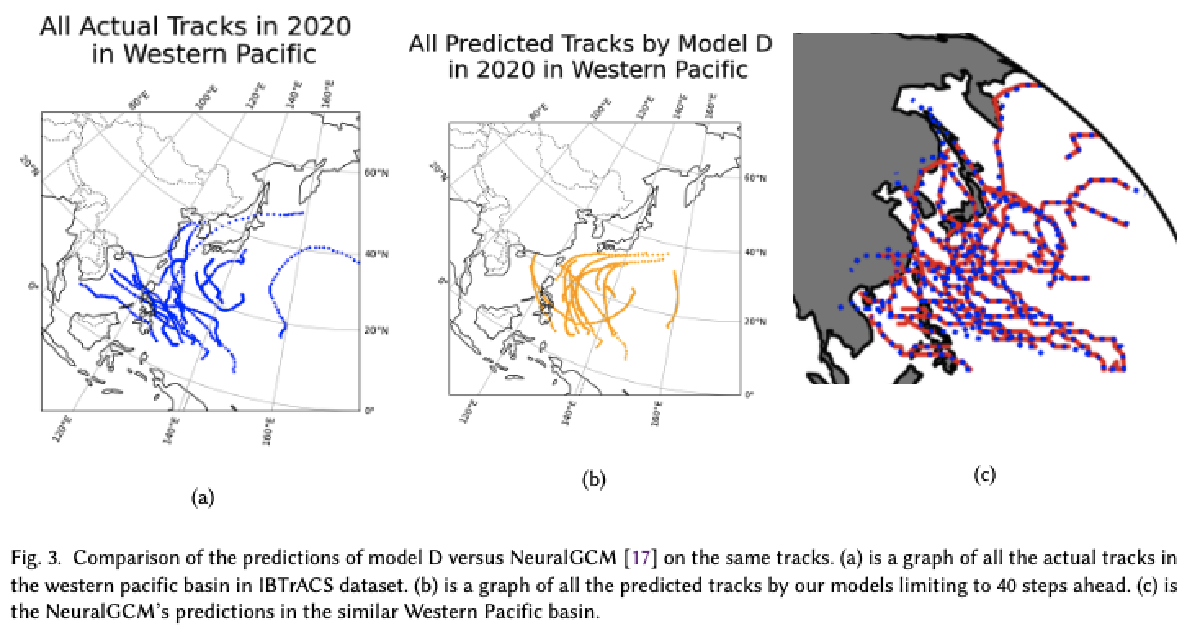
But here’s the kicker: when we stacked it up against other modern deep learning models—you know, the complicated ones with all the bells and whistles—our model actually outperformed them by an average of 147.5% in RMSE. Simpler really can be better.
Why This Matters#
The big takeaway? You don’t always need a massive model to get solid results. LSTMs offer a sweet spot of competitive accuracy without the computational overhead. This could democratize cyclone forecasting—making it faster, cheaper, and more accessible for real-time applications where every second counts.
Dig Deeper#
Want the full technical breakdown? Check out our research paper here.